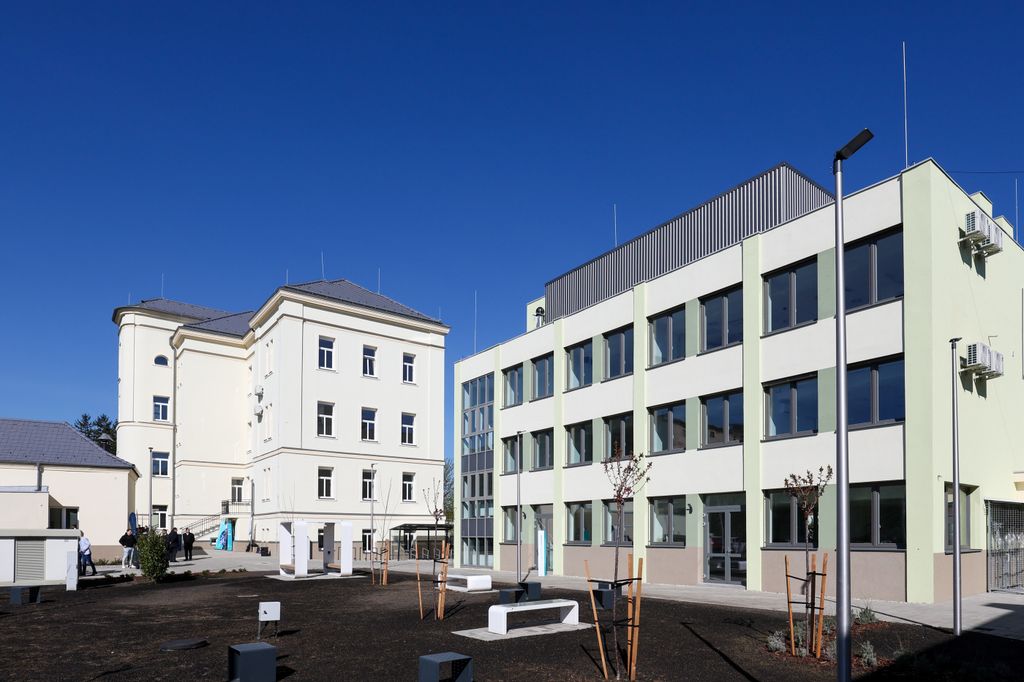
The University of Pannonia is committed to strengthening its international competitiveness in the fields of education and research. As part of this commitment, the University aims to provide students and faculty members across all of its campuses with 21st-century infrastructure. A major contribution to this goal is the project RRF-2.1.2-21-2022-00007, entitled “Practice-Oriented Infrastructure and Skills Development Reform at the University of Pannonia”, which has now reached a significant milestone in its implementation. The project is being implemented within the framework of the Széchenyi Plan Plus program, with a total funding allocation of nearly HUF 4 billion, of which the value of the current infrastructure development amounts to HUF 1.3 billion.
One of the key elements of the project is the expansion of the educational and research portfolio of the Ernő Soós Research and Development Center, which operates as part of the University’s Circular Economy University Center, as well as the establishment of new, practice-oriented, modern training and research capacities.
To this end, as a first step, the University purchased the approximately 4,000-square-metre property located at 8 Vár Street in Nagykanizsa. As part of the development now underway, the building is undergoing comprehensive energy-efficiency and interior modernization. The works began in February 2025 with the handover of the construction site and are scheduled for completion in spring 2026. At a press conference held on
Thursday to present the project, the details of the energy-efficiency investment and the professional objectives to be achieved through the project were also presented.
Dr Renáta Berta Gelencsérné , Director General, said that the ongoing renovation will create a modern and innovative education and research center in Nagykanizsa, serving both scientific advancement and talent development. The new facility will provide opportunities for cutting-edge water technology research as well as related analytical measurements. A distinctive feature of the facility is that part of it will be dedicated to microplastic research in a specially designed, plastic-minimized laboratory. In addition to water-related research, developments connected to renewable energy will also play a prominent role: the building will be suitable for the installation and testing of various experimental systems, known as pilot facilities. The investment also places particular emphasis on the future of young people: a dedicated section of the building will be used for talent development, where primary and secondary school students will be able to develop their skills in an inspiring, modern laboratory environment.
“The Board of Trustees of the Foundation for the University of Pannonia supports the University’s strategic objective of working together with the economic, social and public administration leaders of the region to identify and develop the industrial and service sectors that will shape the future. The Nagykanizsa development fits naturally into this shared vision, as the investment will create modern educational and research facilities that provide world-class support for the circular economy, and in particular for the Hungarian water industry,” said Dr Zoltán Birkner**, Chairman of the Board of Trustees of the Foundation for the University of Pannonia.**
Réka Bodó**, Vice Chancellor of the University of Pannonia, said that the investment now getting underway is of outstanding significance, both in terms of its scale and its symbolic importance. On the one hand, no development of a comparable scale has taken place since the Nagykanizsa campus was established 25 years ago, and the project will significantly increase the University’s educational and research capacities both in the city and across the region. “On the other hand – and perhaps more importantly – the message from the University of Pannonia is clear: we are thinking long term, we are expanding our educational and innovation capabilities, and we intend to play an active role in economic development in the region,” Réka Bodó said.**
“For any city or region, including Nagykanizsa, success and the ability to shape its future depend on having the capacity for research, development and innovation, as well as on being able to harness the knowledge generated locally. A university campus is a key platform for this,” Jácint Horváth , Mayor of Nagykanizsa, said. He added that the university center in Nagykanizsa is also open to knowledge areas and offers programs in fields with a strong tradition in the city. In addition to tourism, research and education in water management and water purification are also conducted at a high level. International students have also become part of the campus community, alongside
students participating in doctoral programs, which he described as a key factor in globally embedded knowledge transfer. “The circular economy and social approach, which is regarded as a leading field both globally and in Europe, has found a home here within the University of Pannonia, and it is an indispensable element of a sustainable future,” he said.
Péter Cseresnyés , Member of the Hungarian Parliament, said that the Nagykanizsa campus of the University of Pannonia plays an important role in higher education in the region. This is particularly beneficial for students from Zala County, as it enables them to pursue their studies locally, without the need for travel and the additional costs associated with it.
He also highlighted the importance of the Nagykanizsa research center, which has been operating for more than ten years. The institution plays an important role not only in education and research but also in the local economy, as the work carried out at the research center contributes to the development and competitiveness of companies operating in the fields of water treatment and water softening.
For more information about the project, please visit rrf212.uni-pannon.hu.